




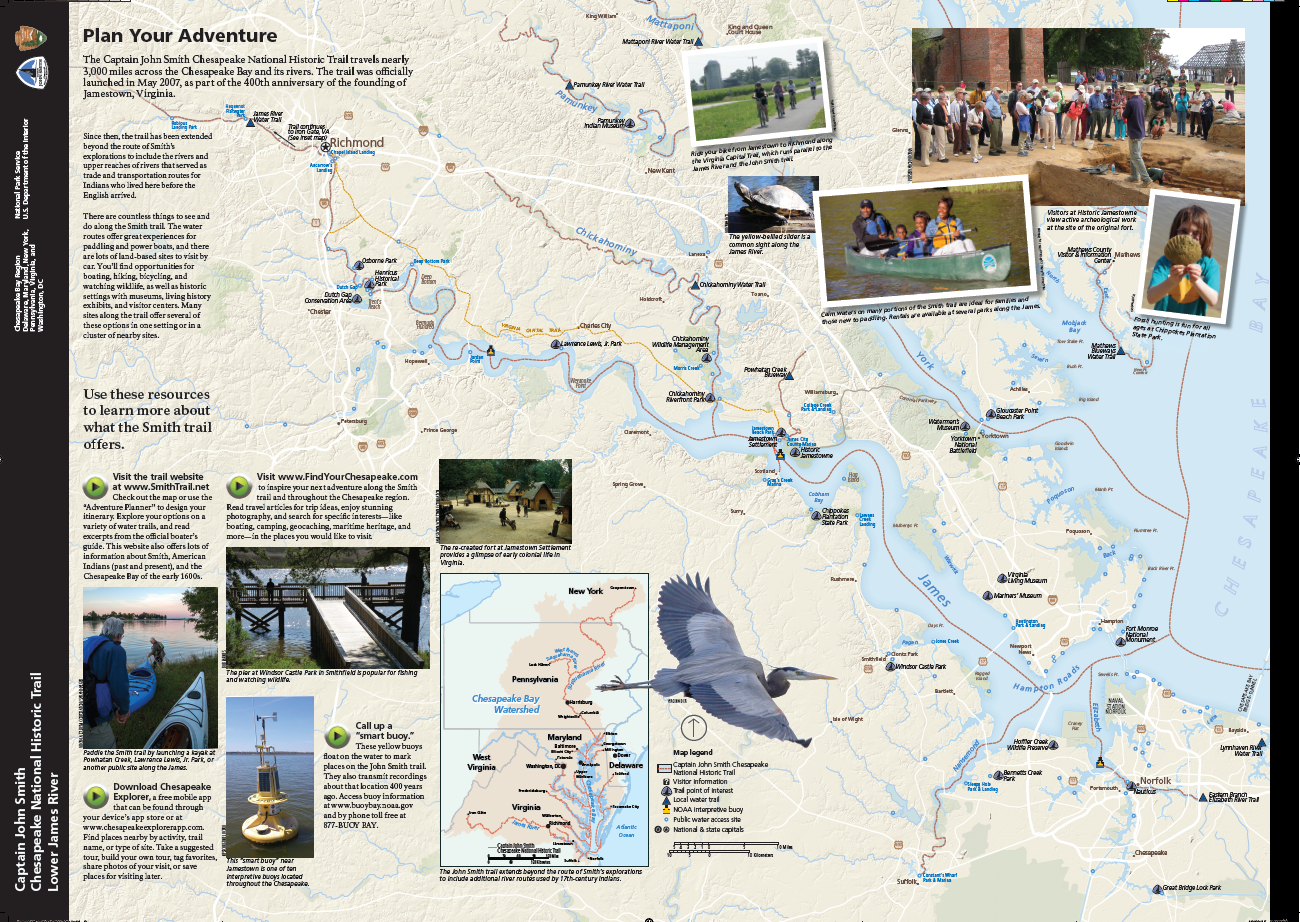
Deep Bottom Park is special not only for its historic significance, but also for its position on a unique part of the James River known as — the oxbow. The U-shape bend of the river at this section of the James resembles the harness for an ox. The river in this section is also unusually deep, hence the name of the park.

“…Gabriel Archer, who along with John Smith and a band of other Jamestown colonists first traveled through here in May 1607, estimated the depth at “five or six fadom eight oars’ length from the shore.” ” – National Park Service, US Department of Interior.
This portion of the river is also part of the Captain John Smith Chesapeake national Historic Trail, one of only two water trails designated as a “National Historic Trail”, the other being the Star-Spangled Banner National Historic Trail. The Captain John Smith trail consists of a series of waterways in the eastern USA covering approximately 3000 miles (4800km) flowing along the Chesapeake Bay. The waterways are of historic significance as they trace the 1607-1609 voyages of Captain John Smith on his expedition to chart the land and waterways of the Chesapeake.

Deep Bottom Park is a quiet and small getaway on the James River. About 20 minutes out from Richmond, the park provides access to the two boat ramps – one is a canoe launch facing Four Mile Creek, and the second is the main boat launch out to the James River. This section of the James River is uncharacteristically deep (hence the name of the park).
We were blessed with another beautiful spring day. The sun was out with temperatures in the low 60s F. Although not designed as a biking trail, our toddler found plenty of suitable ground to blaze through. We spent most of our time at the canoe launch, where we had the dock all to ourselves. From here, we were able to immerse ourselves into the surroundings and the wildlife welcomed us. We saw a large osprey, a large blue heron, fish jumping out of the water and countless frogs and tadpoles and everything in between.

 From what I could see from the dock, the waterway up to Four Mile Creek, looked like a good one to paddle. The water was calm, and the wildlife viewing appeared promising. Whether your interest is history, wildlife, the river or fishing, there is something here for everyone. (Be safe out there, and always make sure you have your personal flotation device, PFDs).


Deep Bottom Park also offers picnic facilities, restrooms, and fishing are available at this site. The boat ramps are available twenty-four hours a day to launch and retrieve boats. The park grounds are open from dawn to dusk.
9525 Deep Bottom Road | Henrico, VA 23231


 The transition period from March to April is one of the prettiest times of year in Virginia. Cherry blossoms make their display, snowing petals in the gentle breeze for just a couple of weeks before the landscape flourishes with green. It is also the nicest time of year to go scouting for new clear waters to paddle. The mountains to the west is where I have the best luck in finding such waters. While the coastal plains of Virginia offer incredible wildlife and scenery to paddle in, I’ve always been in love with the backdrop of a bare forest against a sparkling mountain lake. In my heart, Lake Moomaw and Switzer lake hold the top two spots in my ranking of favorite Virginia mountain lakes, but I’m always open to see if they can be dethroned.

 With two kids in tow, (Lake moomaw and switzer lake) are just a tad too far for a daytrip. (3.5 hours and 2.5 hours respectively). A quick look at a map of Virginia led me to investigate the Ragged Mountain Natural Natural in Charlottesville, Virginia.
At an elevation of 737 ft. This beautiful 980-acre region is home to the charlottesville reservoir, a gorgeous clear lake with more than 4 miles of shoreline. This area offers seven miles of trail through its oak, hickory, pine and maple forests. The densely wooded area is home to white-tailed deer, black bears, bobcats, and dozens of species of birds including the popular pileated woodpecker in this area.


It had been a long time since I’ve used our Deuter Kid Comfort Active (child backpack carrier), actually haven’t used it since Utah (September 2019). Our 2.5 year old has also gained some weight since that time, but we have all been cooped up and ready for a decent hike. We started at the main parking lot and made a 3.0 mile round trip to the floating bridge. This hike is certainly not as remote as Shenandoah National Park, as you can still hear cars on the inner roads but it is still certainly peaceful.

The trails were laid out clearly without any brush (another reason why I like spring hiking). We sat down and had a small snack at the floating bridge before making our way back across the dam and to the main parking area. In front of the parking lot are several picnic tables with a great view of the lake. We sat down and had lunch in the brisk spring breeze after working up a sweat. Down at the canoe launch are actually several canoes and kayaks that people just leave there unattended on the racks. I told our son that we would be back to paddle this lake one day, when it wasn’t as cold.
Whether you come here for the trails, water or wildlife, there is something here for everyone. It is a great trail for kids too, as it is not too strenuous. Stay healthy, stay safe everyone.

Directions (open 7:00am to sunset)
Physical Address: 1730 Reservoir Rd., Charlottesville, VA 22903
From I-64 in Charlottesville, take Exit #118B/US 29 North. After 0.4 miles, take the first exit for US 29 Business. At the end of the ramp, turn left onto Fontaine Avenue. Go 0.3 miles on Fontaine Avenue to Reservoir Road and turn right. Follow Reservoir Road for 1.7 miles to the sign on the right just before Camp Holiday Trails. This is the lower parking area. To reach the upper parking area, continue past the lower lot, stay right and pass the yellow gate, and travel up the paved road to the top of the dam and park by the kiosk and tool shed.
The City of Charlottesville owns and manages the land, parking areas, and trails at Ragged Mountain. The Rivanna Water and Sewer Authority manages the water and related infrastructure.
Dogs are not allowed at Ragged Mountain natural area (other than approved ADA service dogs).

On my last day of break, I wanted to take the family out to explore the freshwater tidal marsh areas of R. Garland Dodd Park in Chesterfield County, Virginia on the Appomatox River. The park spans 176 acres and offers something for everyone of all ages. Apart from the beautiful 2.7 miles of walking trails, there are 2 baseball fields, 2 basketball courts, a football field and 6 tennis courts which are all lighted. There are also 4 soccer fields and two different sets of playgrounds, and numerous shelters.
 The main attraction to the park is the floating boardwalk through the Ashton Creek Marsh. In the heart of winter, the place seemed desolate but still very beautiful. I imagine that in the summer, this place would be teeming with wildlife; birds, turtles, and dragonflies to mention a few. We enjoyed the very short hike down to the first Marsh Overlook where the floating board walk begins. Interestingly, at this location is another playground area which seems to be almost hidden in the woods. Our son very much enjoyed the floating boardwalk, as he hopped over the panels to avoid the small gaps. With walking stick in hand he explored the marsh and the plants, marveled at the ducks as they flew in formation and observed the sporadic movements of the dozens of tadpoles.


At the age of 28 months, he is a very capable hiker on flat terrain such as this. Towards the South Gully Bridge is a beautiful outlook on the Appomatox as the marsh opens up into flowing river water. This area is interestingly of historic significance as well. This land was the southern end of the Union position during the Bermuda Hundred Campaign. These were a series of battles fought at the town fo Bermuda Hundred during May of 1864 during the American Civil War. There is evidence of the Union Army’s earthworks in the area however relic hunting is prohibited in the park.


The park is listed as “at Point of Rocks”. The Point of Rocks is a plantation home that was built in 1840 of historic significance during the civil war. It was named after the 60 foot high sandstone cliffs on the Appomattox River. The house had signficance as an observation point during the war for Union General Benjamin F. Butler. It was used for a time as a hospital as well. The home today is owned privately by descendants of John Strachan, but part of the land is part of the park today.
Whether you come for the views, the sports or the history, there is certainly plenty to explore at R. Garland Dodd Park. (30 minutes away from Richmond, VA)


A nice Tuesday off had our family seeking the outdoors for a nice change of scenery. We head to our closest state park, Pocahontas for a stroll through the forest and playground with our toddler.
It is obvious to me that he feels the same sense of freedom and bliss that I experience when I am outside. It’s probably only natural that we all humans feel this way. We have evolved and have been wired to spend our time outside. The energy that is poured through the body when you are outside is certainly palpable.

Interestingly, the act of physicians prescribing “outdoor time” for their patients has picked up significant momentum in recent years. Especially in Canada and Europe. Keep in mind that this is distinctly different from an exercise prescription. The mere act of being outside has been linked to help treat, high blood pressure, diabetes, obesity, depression, anxiety and several other chronic maladies.
Even on this cold and cloudy January day, this little kid is happy as a clam to explore treasures of the forest.
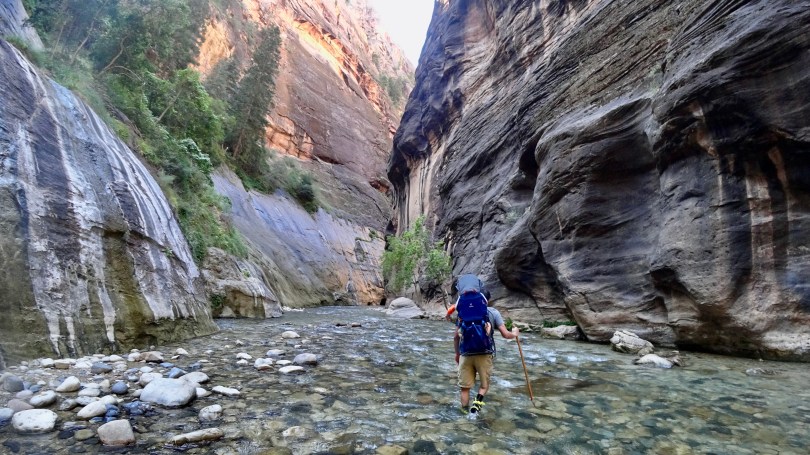
The highlight of our 10 day road trip through the Utah Mighty Five was hiking the narrows with our toddler. This was shot with the Sony FDR X3000 action camera.

One of my favorite shots while on our 10 day road trip through the Utah Mighty Five. This was shot with the Sony FDR X3000 action cam. It was the only lens that was wide enough to capture the whole scene.

The winters in Virginia continue to get warmer and warmer. We have not yet had our first real snow fall yet and it is mid January. 2019 was the 2nd hottest year in recorded history, falling just behind the year 2016. The effects of climate change have made itself blatantly clear all over the world. The australian wildfires, rising sea levels and record shattering heat waves. This past weekend, it was 70 F in Richmond, Virginia! It was unsettling warm and sunny, we made the most of this situation and decided to venture to a new local park at the recommendation of a friend. We made our way to Three Lakes Park in Chamberlayne, Virginia.


Our son was eager to run once again in open space. He had been cooped up and had a mild case of cabin fever. He grinned from ear to ear as he sped through the forest. Nothing beats real world interaction to solidify things that he has read in his books. He was able to identify several birds and ducks as different parts of the tree. While we were walking, I realized that everything seemed just a little bit easier. I then realized at 27 months, he is now able to hike on his own! We completed a circuit just under 1 mile and he was able to walk the entire way! He even found a little hiking stick to call his own. After spending some time throwing rocks in the lake, he spent his energy on the large playground until the Nature Center opened at 12:00pm.


There’s no question that the future of our planet is at stake. We are all stewards of the planet, and we can dictate its course. We can either change the speed at which it is damaged, or change the speed at which it is recovered. Most importantly is the fact that the future is in the hands of our children. Get them outside to enjoy the beauty of our planet, so they know what it is exactly that they will be fighting to protect. A small act performed by millions can change the world. Start with your local conservation organization. 

As we enter the heart of autum, I reflect on the weird garden we picked from this past season. We didn’t intentionally grow a garden this year, but it grew anyway. In the middle of summer, the tomato vines were growing out of control from our initial planting 2 years ago. This prompted me to look up which vegetables were actual annual vs perennial (survives for longer than 2 years).
Minh and I were forced to put up the foundation to keep them from overtaking our lawn. I’ve never seen more grape tomatoes! Minh thoroughly enjoyed the task of weeding and tending to the tomatoes. He’s an industrious little fellow. Another perennial plant in our garden is the raspberry bush in the corner. The raspberry bush did quite well this year and it yielded more berries than the year before. Minh was particularly excited about that. We are well into autumn now and the fruits are all picked.
 Upon further reading, it looks like with proper care, the raspberry bush should continue to deliver more berries year after year. One thing, we haven’t been doing is pruning. The branches (also called canes) that bear fruit, only live for two summers. In the first year, the new cane is green. It eventually is enveloped in a brown bark and lies dormant in winter. When it warms again, it becomes a “floricane” which yields berries in early to mid summer and dies. I guess I’m going to have to start pruning the dead canes.


In the spot where we leave our rotting pumpkins, it looked like an extensive vine groundwork was laid however, but we didn’t see any pumpkins, I suspect that the buds were eaten by the local squirrels. Alas, next year we shall be ready for a real harvest….
 We were all very impressed by Three Lakes Park & Nature Center. The trails were flat and easy for the kids and the impressive 6,500 square foot Nature Center is one of the nicest we’ve ventured to. There is a 50,000 gallon aquarium which gives visitors a “fish-eye” view of the underwater world. Our son thoroughly enjoyed this center as he explored the migration patterns of the birds, and marveled at the number of turtle species in the tanks! The nature center is open from 12:00pm to 4:00pm most days and is free admission.

