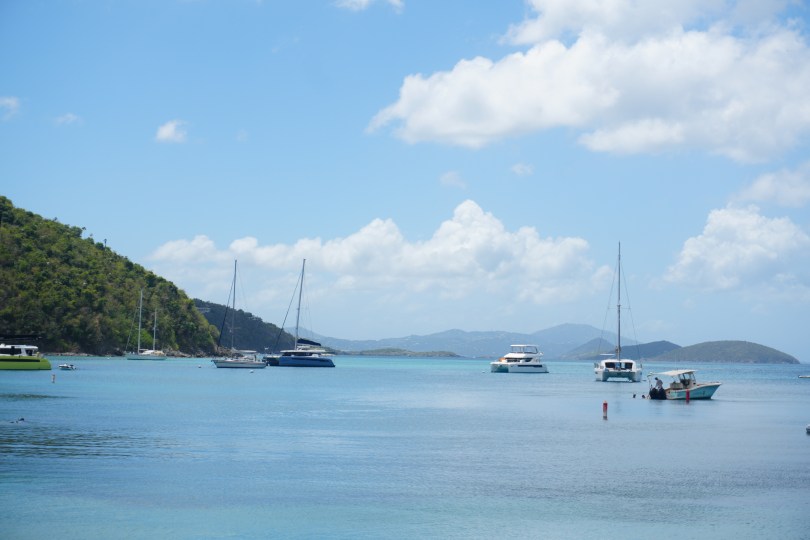
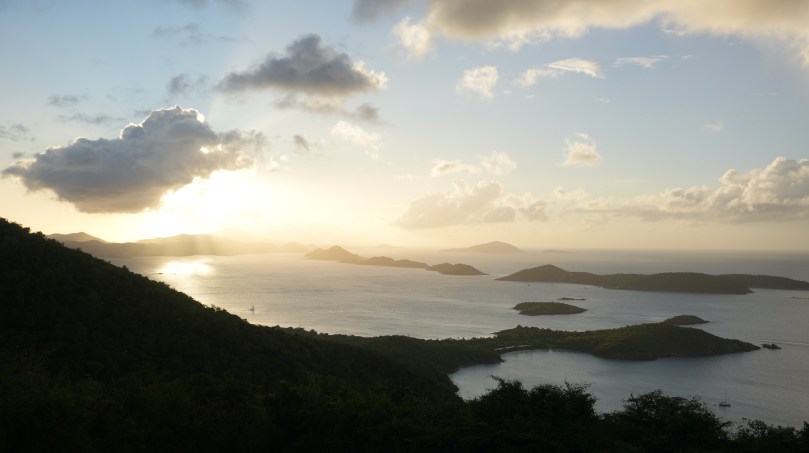
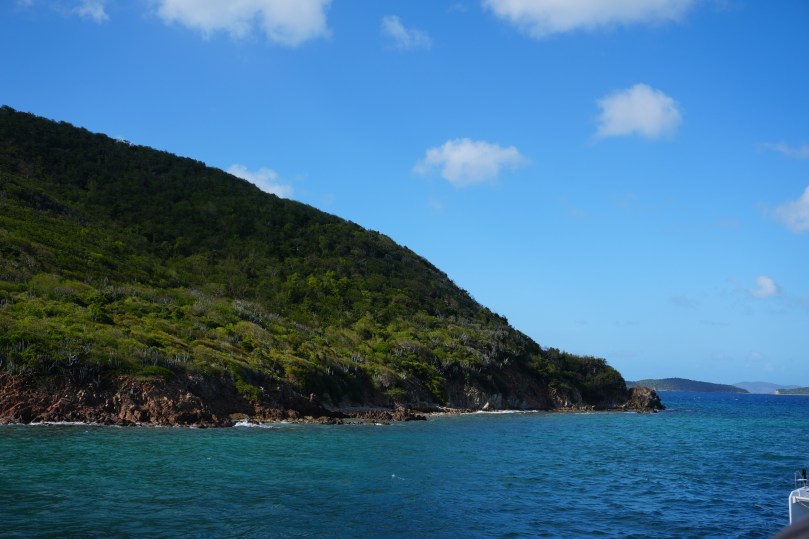
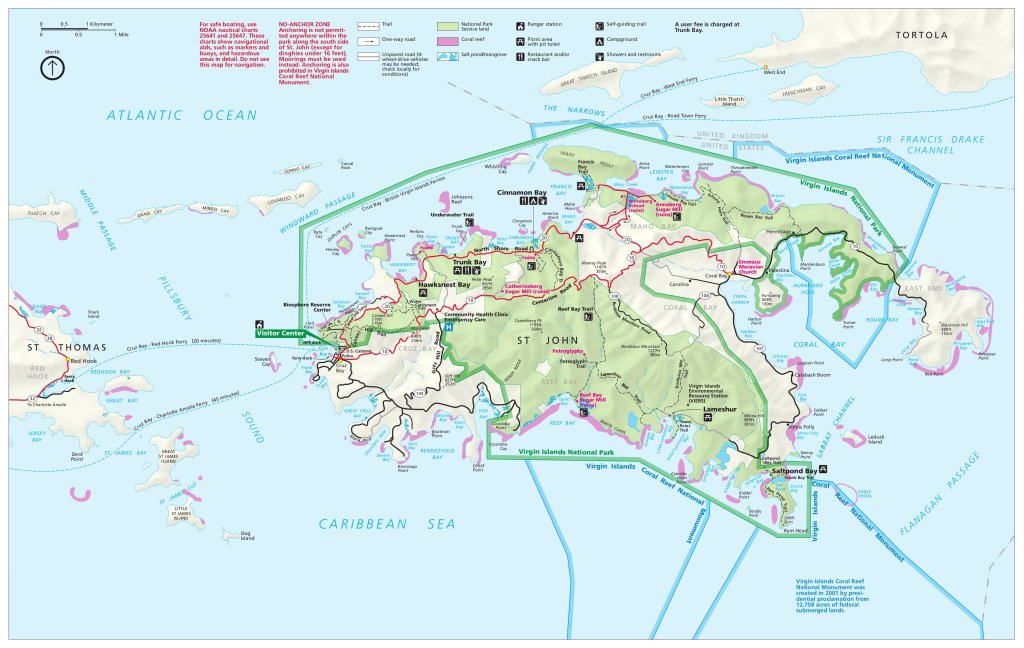
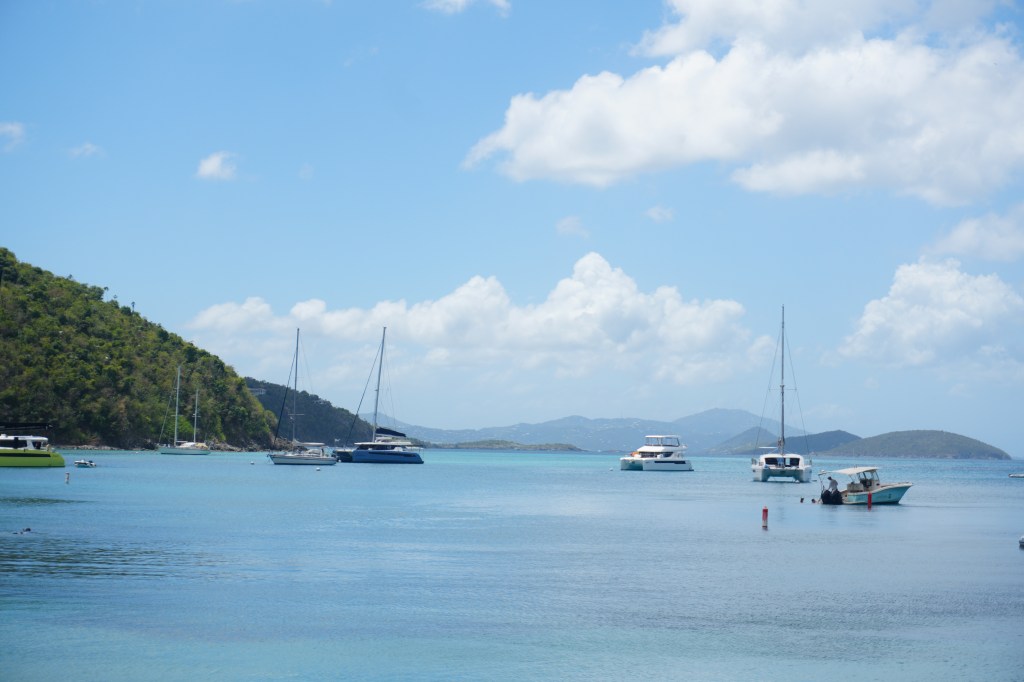
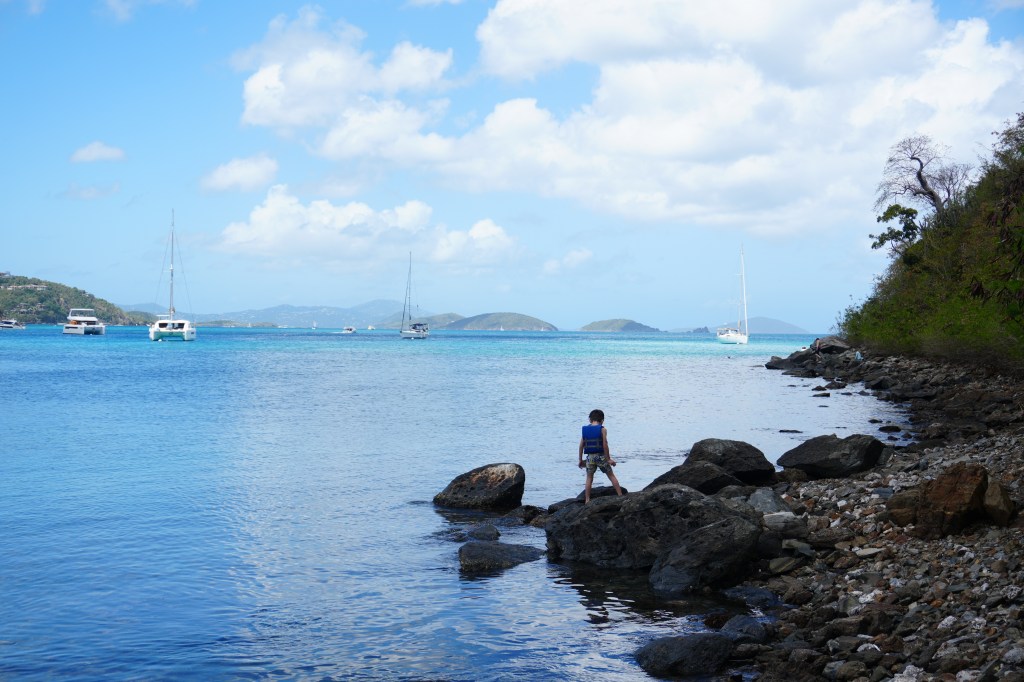
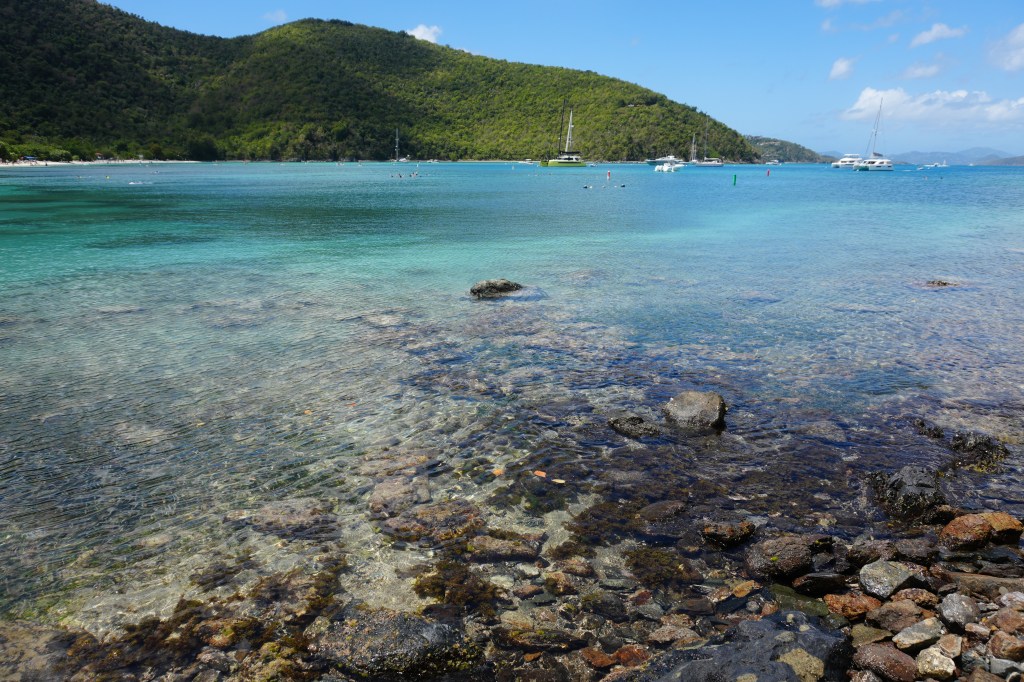
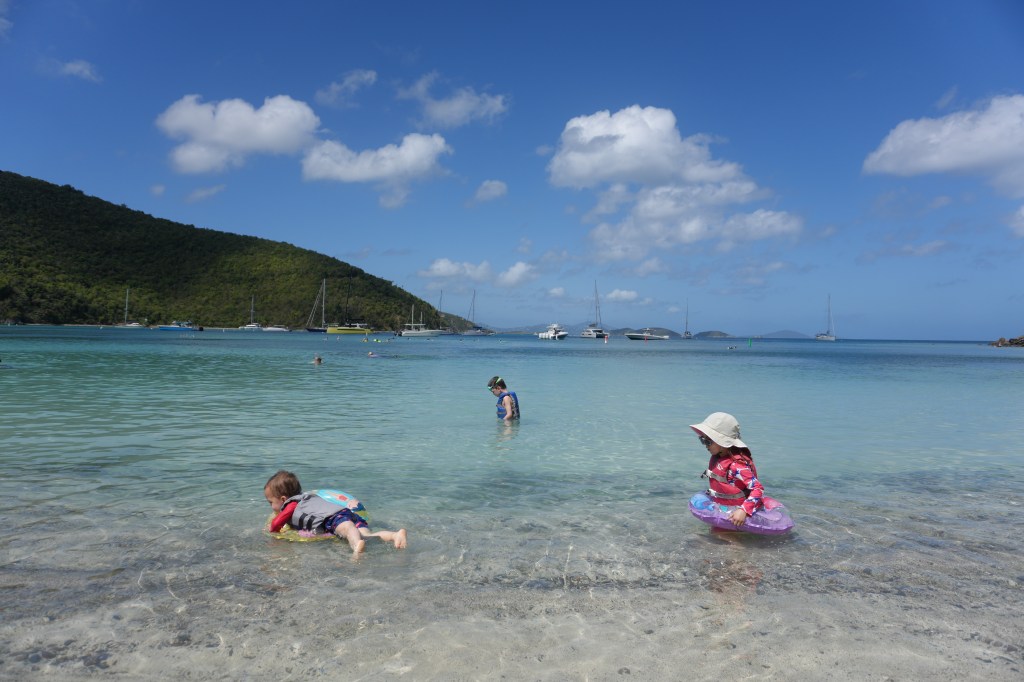
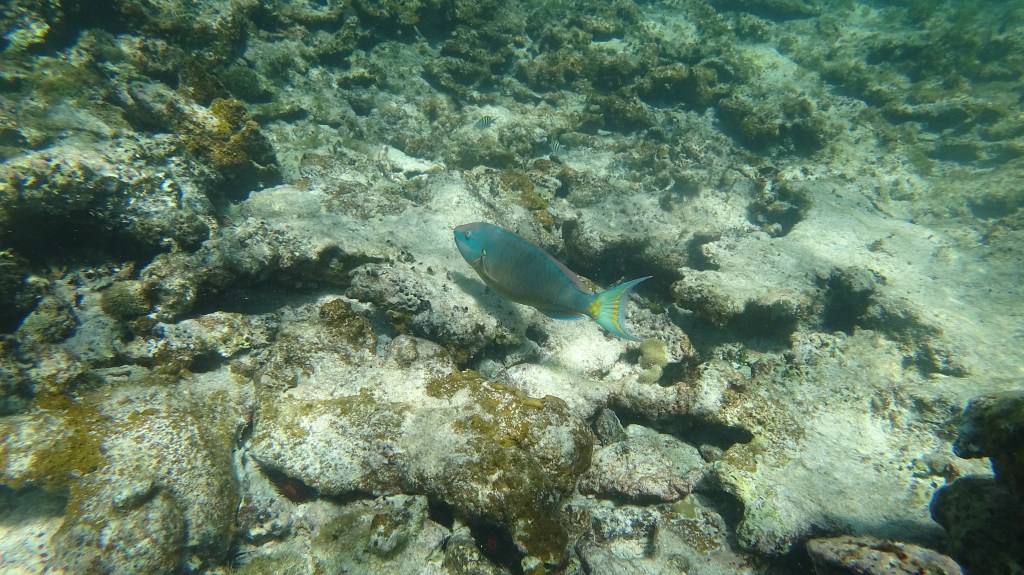
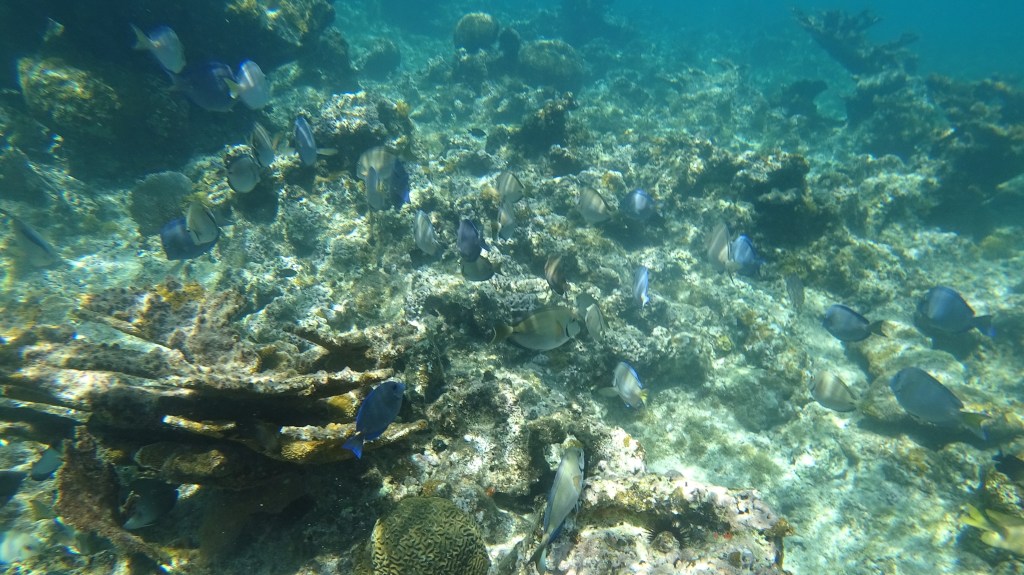
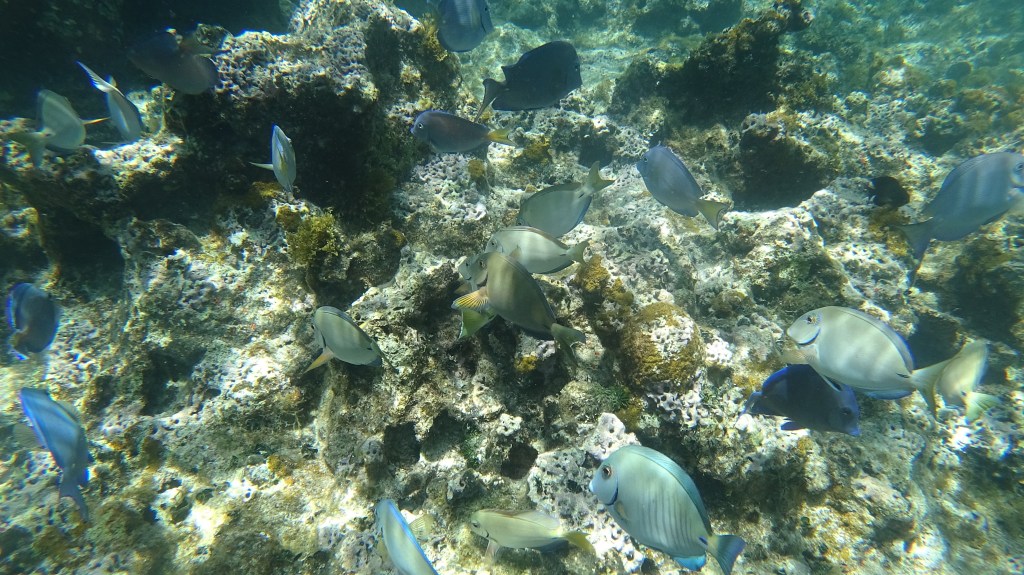
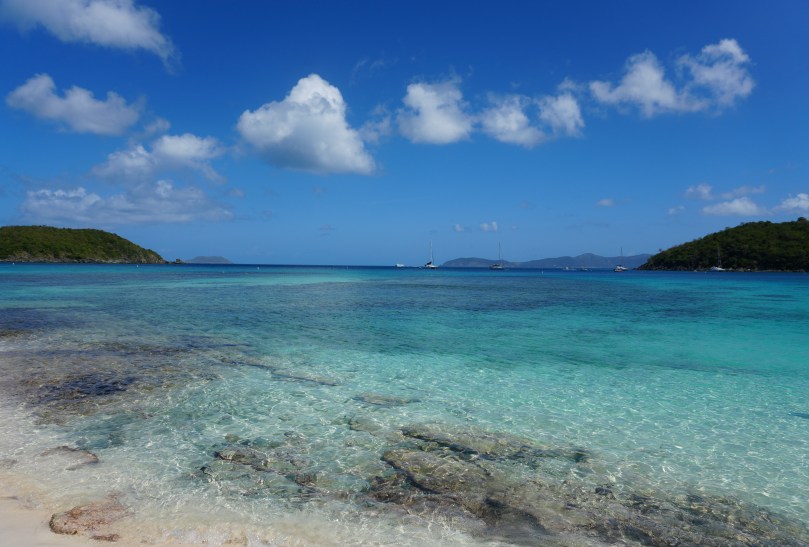
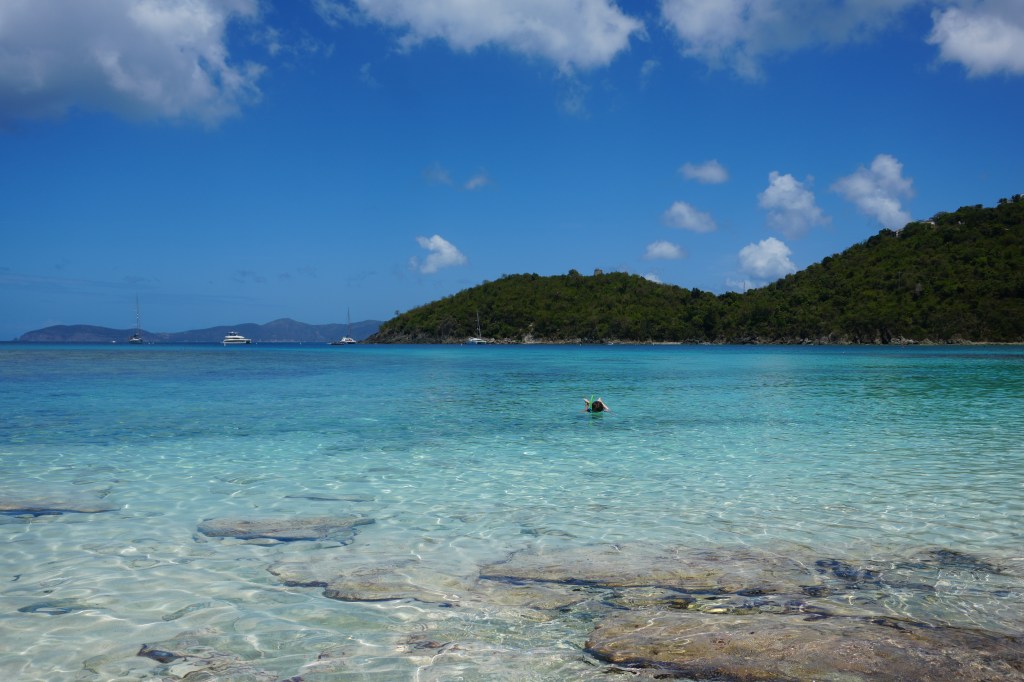
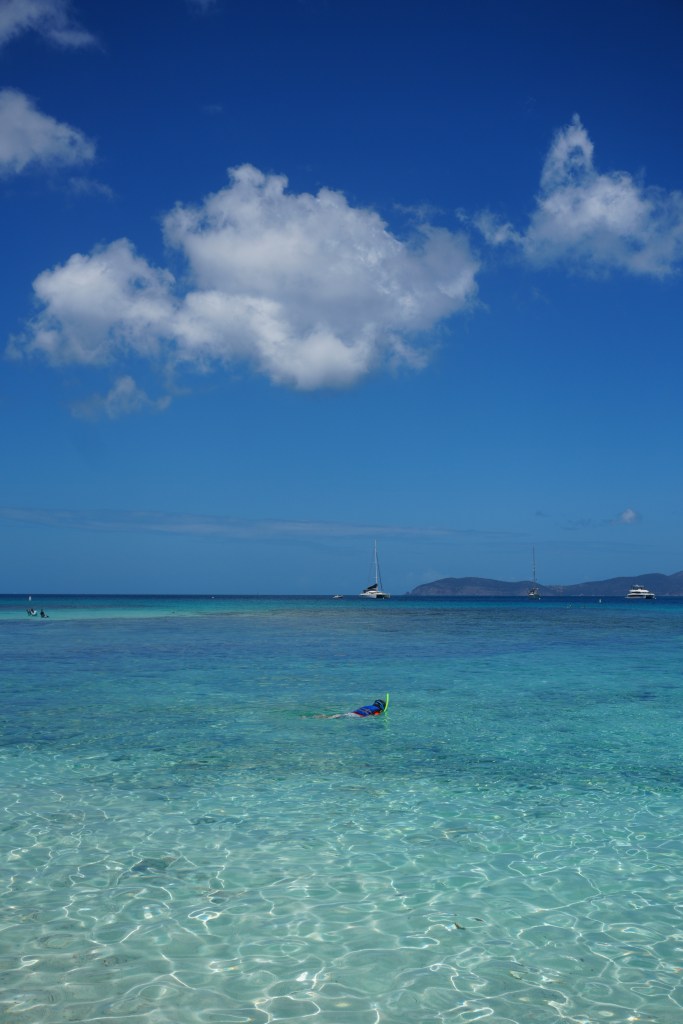
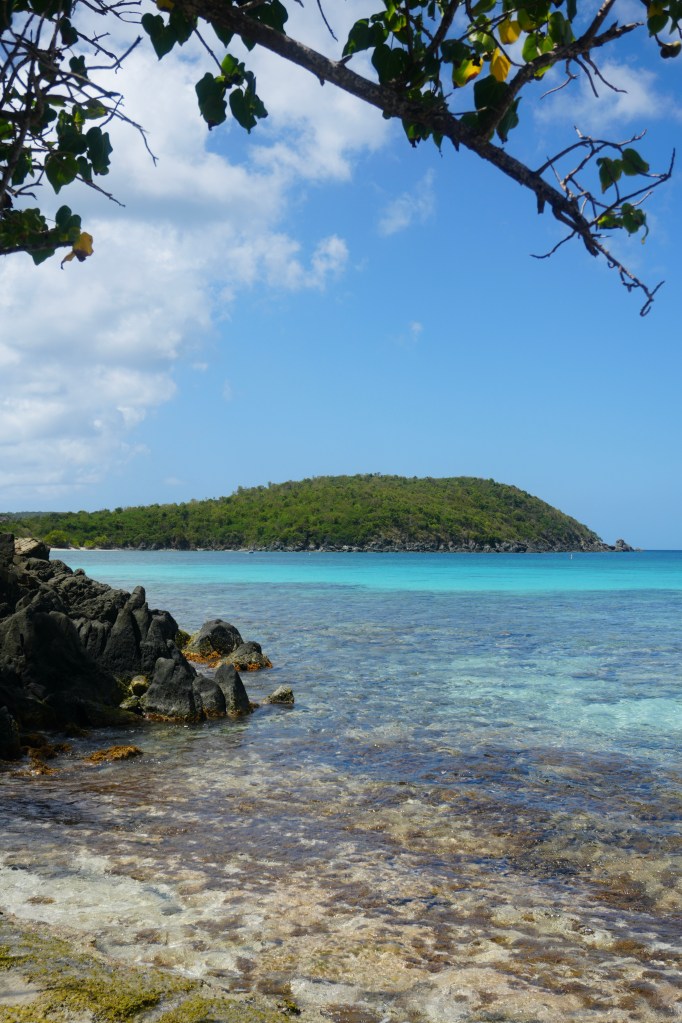
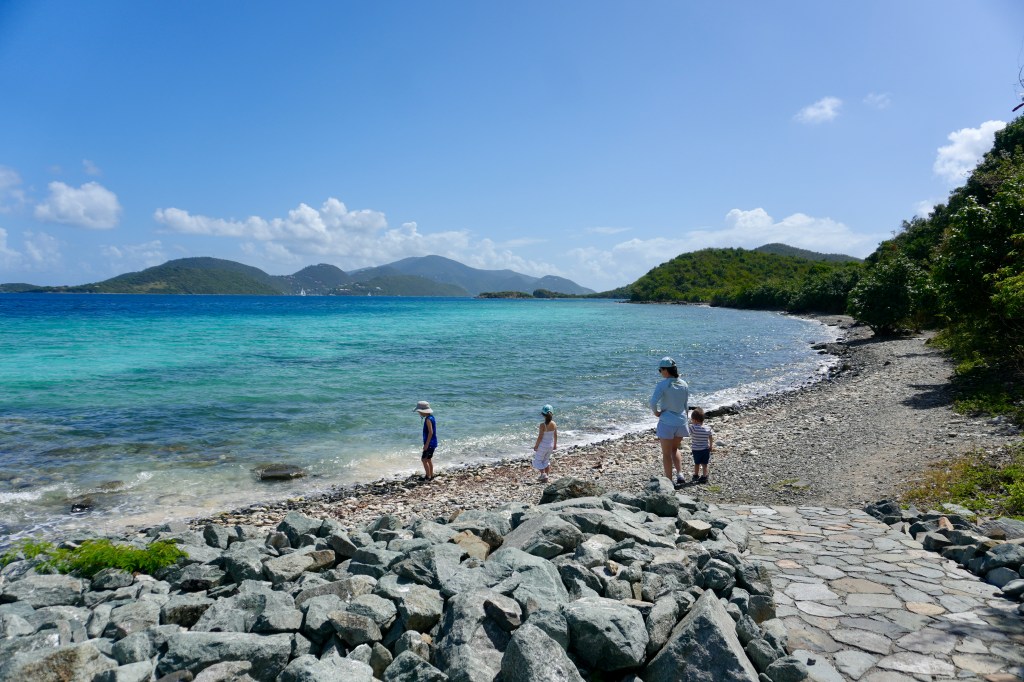
Of all 63 national parks of the United States, Virgin Islands National Park is one of the most remote. Located on Saint John, an island in the Caribbean Sea, Virgin Islands National Park covers nearly 15,000 acres of lush tropical forests, white sand beaches, mesmorizing snorkeling and a thriving wildlife scene. The national park covers approximately 60% of the island of Saint John and is protected under the national parks system.
Our last big trip to a national park was years ago when we took on Utah’s Mighty 5 National Parks. Six years and two more kids later, we felt like we finally had the gumption to go on another big adventure.
In the last week of March we embarked on two flights and arrived in Charlotte Amalie, the capital of the Virgin Islands on St. Thomas Island.
From here we took a ferry across the Pillsbury Sound to reach St. John. Upon arrival, the warm and humid air hits you in a pleasant way after a long winter. Colorful homes are situated in all layers of the island, giving you a sense of the mountainous terrain to be traveled ahead. Influenced by its Danish colonial background, the cars drive on the left hand side of the road. The people are nice and the bugs are out at night. We made it. We stayed in the Cruz Bay area, where several local markets, made it easy to get food and supplies for the week.
As beautiful as the islands are, the Virgin islands bear a dark history of Danish colonialism. In the 1600s, Denmark fought and cliamed St. Thomas and St. John for its West Indies colony. Their plan was to grow cotton and sugar, powered by a labor force of indentured Europeans. This proved to be not viable, based on supply and demand. Supplied by a Danish fort in Ghana, slaves were sold to the Virgin island colonies. Over the 200 years, 85,000 slaves were sent to the Virgin islands.
After years of rebellion and reckoning, the United States purchased the Danish West Indies after world war 1 in 1917. The Virgin Islands National Park was established in 1956.
In the last week of March, the weather in the Virgin Islands was sunny, with lows of 78 degrees high of 81 degrees. We explored mostly the northern end of Virgin Islands National Park.
Day 1 – Maho Bay – North Shore
Maho beach features 0.3 miles of white sandy beach, and is known for its larger areas of seagrass, attracting sea turtles. The calmer waters of Maho bay make it a popular destination for families. There are several food and drink vendors across the street offering snorkel gear and kayaks. This spot was a good introduction to the national park, it showed us what was in store for the rest of the island.
Day 2 Hawks Nest Bay
Hawks Nest Bay was one of our favorite spots. It is one of the closest access points to the entrance which led me to believe that it would be crowded. Surprisngly, it turned out to be a very peaceful spot with excellent snorkeling. The stretch of beach was also home to many small hermit crabs that scuttled around. Hawks nest was where I was able to first begin to understand the rich wildlife and amazing network of the coral reefs.
Day 3 Hike to Waterlemon Cay (Leinster Bat Trail) – high 82, low 77 occasional showers
With a forecast predicting heavy showers throughout the day, we decided to venture out to the waterlemon cay to bay hiked the Leinster Bay trail. This was an easy 0.8 mile flat hike along the coast. It is one of the few flat hikes in the national park and perfect for little kids as well. This hike takes you through some shady areas, with beautiful flowers, and wildlife along the way. The hike along the coast certainly makes you feel small as we gazed out to the vast sea. The pelicans, sea turtles and hermit crabs were all out to play. Most people hike the Leinster Bay Trail to get access to Waterlemon Cay (boasting some of the best snorkeling on St. John.)
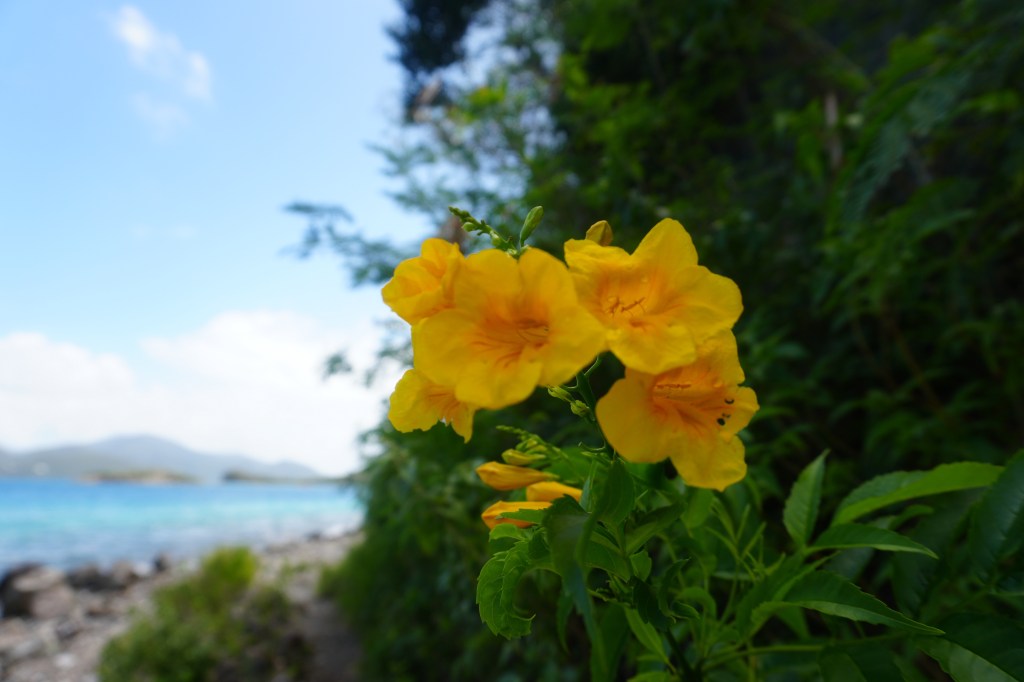
Pictured above: The yellow flower of Tecoma Stans (aka: Ginger Thomas, Yellow Elder) is the official flower of the US Virgin Islands. Interestingly, it is not a native flower, however the species has been highly successful in the caribbean.
Day 4 – Trunk Bay – High 81F, low 77F windy
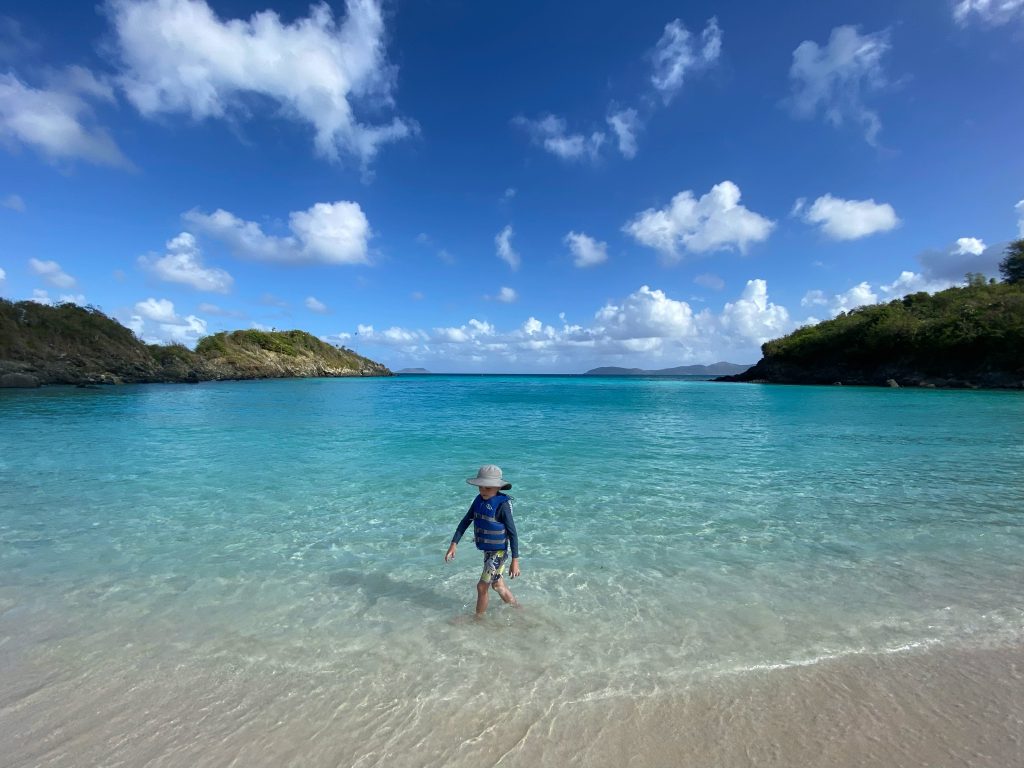
Probably one of the busiest beaches in the beach, Trunk Bay is known for it’s snorkeling and an underwater snorkel trail. With a larger opening to the sea, the water was choppier here and it looked like good generate enough swells for some surfers on certain days. This area of the park had plenty of food, drink, rentals chairs, and sports equipment for rent.
We live on such a beautiful planet, and Virgin Islands National Park is a prime example of that beauty. Please remember to respect the land, water and reefs when you pay a visit to this spectacular national park.
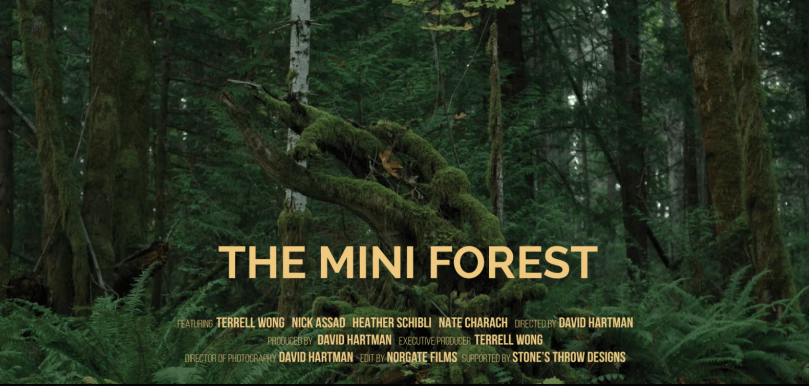
David Hartman is one of my favorite film makers. Based out of Ontario, Canada, his messages and themes hit close to home for me. His filming style is thoughtful, well-paced, beautiful and a breath of fresh air compared to the overstimulating films and movies of today. I came across “The Mini Forest” and thought I would share. The film speaks to sustainability, growth, and how our individual actions can have profound effects on the earth. It has certainly got me thinking about my own lawn…
“Terrell Wong is about to plant 100 trees in her small Toronto backyard, a dense mini forest based on the Miyawaki Method. What at first seems like a simple act soon evolves into a complex story about dirt, lawns, fungus, wildlife, native species, and finally the human brain. An anti-lawn anthem from director David Hartman, The Mini Forest explores this innovative form of afforestation and the importance of restoring the native woodlands that once covered so much of Canada and the World.”
I hope everyone is having a safe and happy holiday season. Things can be especially busy and hectic this time of year so don’t forget to take some chill time, relax, go outside, or watch a canoe documentary. I found this one recently online and it’s pretty awesome. This one features 6 friends who spend 2 months in the Yukon and Peel watershed. Happy Holidays everyone.
“This documentary is a captivating documentary chronicling the 1,500-kilometer, two-month canoeing expedition of six adventurers through the pristine wilderness of Canada’s Yukon and Peel Watershed. This thrilling journey traverses six rivers in three canoes, capturing not only breathtaking landscapes but also the profound cultural and ecological significance of the area. A chance encounter with a First Nations family transforms their adventure into a mission to spotlight the urgent need to protect this fragile and unique ecosystem from industrial development. The film blends the grit of exploration with a heartfelt environmental message, showcasing the resilience of nature and the enduring traditions of those who call the North home.”
I’ve spent more time slowly down this Spring and catching up on independent films and documentaries. I came across this gem from The Guardian featuring a man, who lived in Yellowstone National Park, working as the park’s winterkeeper. The story is told beautifully and the videography makes it a joy for the eyes to watch. I hope you all enjoy. Its about 12 minutes long.
“Steven Fuller is a winter caretaker who has lived at Yellowstone national park for the past 50 years. As the cold weather approaches and the seasonal transformation begins, he hunkers down in his remote mountain cabin. But Fuller and Yellowstone face an uncertain future, with the climate crisis threatening to forever change one of North America’s last great wildernesses.” – The Guardian
After watching the documentary, I reflected on my own personal experience traveling to America’s first national park in 2018. Yellowstone is really a magical place. I spent only 1 week there but I feel like this already magical place would be even further transformed each season. I hope to go back once my kids are older. Below are some of my favorite shots from Yellowstone National Park in 2018.
In 1872, President Ulysses S. Grant, signed into law, the establishment of the first national park in the United States…Yellowstone National Park. This massive national park covers a whopping 3,468.4 square miles; larger than the states Rhode Island and Delaware. 96% of the park is in Wyoming, 3% in Montana and approximately 1% in Idaho. The stories of Yellowstone and its spectacles are well known to people from all over the world – Old Faithful, the roaming bison, the brilliant springs, and the massive waterfalls.
Minh is thrilled once we reached Gardiner, Montana. The gateway city to the north entrance of Yellowstone National Park.
I wanted to see for my own eyes, the landscapes, wildlife and magic, that inspired a country, to begin protecting and celebrating these areas known as National Parks. In today’s turbulent political climate, it seems as if our country has forgotten about these places, and we are unfortunately heading in the complete opposite direction. More and more wilderness areas are under threat each day, as efforts to seek new resources take priority. At this rate, who knows how much of our planet will be left in 40 years. I wanted to get away from work, politics and the debates and go explore the wild west for myself.
A photographer captures a moment in the black sand basin of Yellowstone National Park
Sarah and I were fortunate enough to be able to rearrange our schedules to have 8 days (5/19-5/26) off together to explore Yellowstone and the Grand Tetons in Wyoming. We realized this was an ambitious trip, considering the fact that we were bringing our 7 month old boy along; but we were eager to adventure as a new family. I quickly learned that traveling with a baby, turned simple trips…into expeditions. We carefully thinned out our luggage so that we could make room for all of Minh’s clothing, toys, food and milk. He did remarkably well over both legs of the flight (Richmond to Atlanta then Atlanta to Bozeman) and then the three hour drive to Yellowstone National Park. We stopped frequently along the way to make sure he could eat, crawl around, and get some fresh air. I actually preferred the slower pace of traveling with a baby. It helped removed us from from our hectic daily routines and pace of life back in Richmond. Minh taught us to slow down and take everything in. We often found ourselves parked next to the road feeding and playing with him in the back seat or trunk. We took in the serene, roadside skylines of Montana and Wyoming without much care for anything else.
Yellowstone, a geothermal wonderland
When planning a trip to Yellowstone, the lodging options are both varied and abundant. We were traveling with a baby so we knew that we wanted to be in the actual park. This would help cut down our travel time each morning and allow us to see as much of the park as possible. For those traveling with some more flexibility, there are several good options to explore, such as small towns just outside Yellowstone (ex. Gardiner and West Yellowstone) or even camping options within the park. We booked one of the last spots in the northern section of Yellowstone at the Canyon lodge. Despite traveling during shoulder season to avoid the crowds, all of the lodges seemed very busy. I could not imagine what it would be like during the summer (peak season).The next morning, we were eager to explore the raw and rugged spaces of Yellowstone in broad daylight. There certainly is a palpable pulse in the earth of Yellowstone. This massive park is centered over the largest super volcano on the continent. The landscape never lets you forget that you are treading over a sleeping giant of a volcano. From the steaming hot springs, bubbling mud pits to the spitting of geysers, this place is certainly alive……..and mighty.
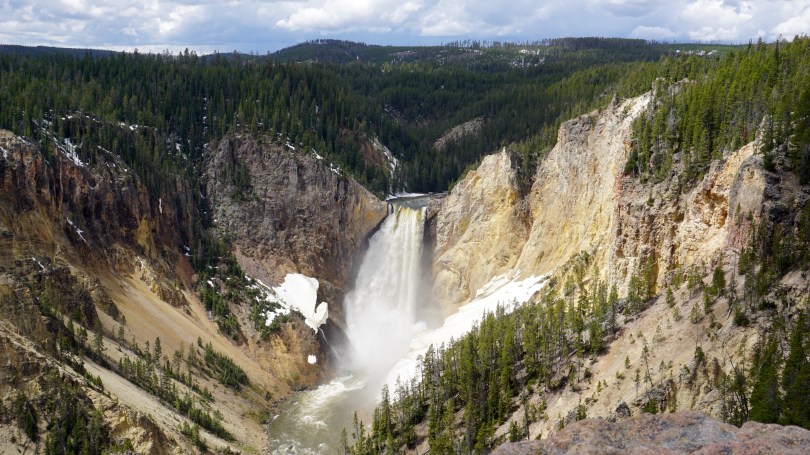
The Grand Canyon of Yellowstone National Park
Yellowstone landscape
As the first national park to be created, Yellowstone certainly makes you feel as if you are at the heart of it all. I’m glad that we packed for all different types of weather, because at 7500ft, things could change really quickly. In the early morning hours, the park is draped in a blanket of fog which clears usually by about 9:00am. We had sunny days for all of our time at Yellowstone which was very lucky considering the forecast predicting light rain and cloudy skies. In true mountain fashion, we were hit with a snow flurry as we were leaving the park. I was surprised to learn that it is not uncommon to get snowfall as late as July!I was also surprised to learn that it took me quite some time to get used to the high altitude. Strenuous activities tired me out faster than usual and I had a very mild headache the first 24 hours. The decrease oxygen concentration is certainly noticeable in my opinion and it is not recommended for people with pre-existing coronary artery disease to travel at such heights. This lower oxygen content could put the coronary arteries of the heart in a dangerous scenario of supply and demand mismatch, leading to worsening ischemia and therefore angina. So if you have pre-existing coronary artery disease, congestive heart failure, or pulmonary hypertension make sure you get cleared by your physician before. (my only medical plug in for this article).
Road warrior
Bison of Yellowstone
Mormon row, Grand Teton National Park
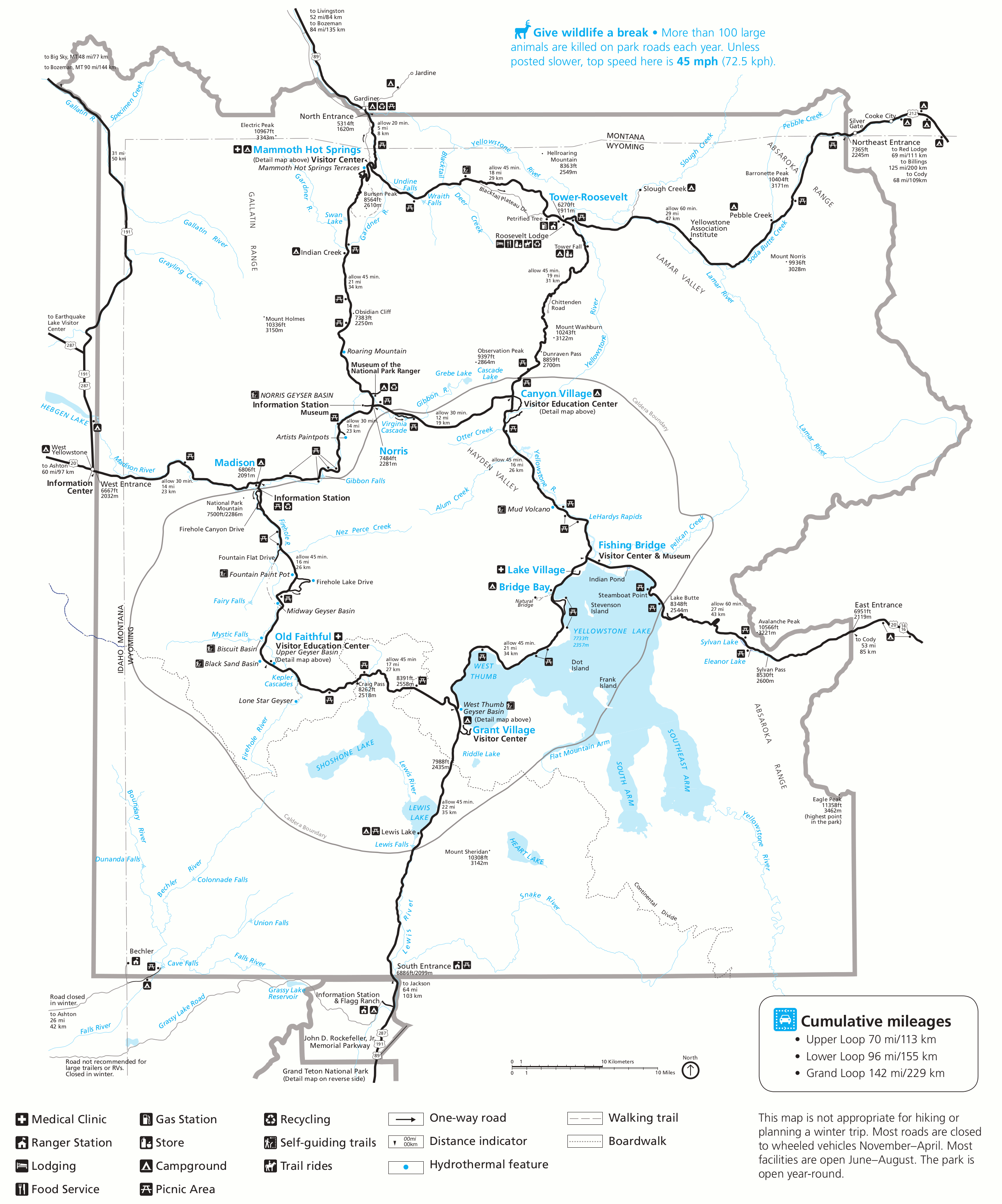
Yellowstone is divided into villages which are centered around main attractions such as Yellowstone Lake, Old Faithful, Grand Canyon of Yellowstone and Mammoth Hot Springs. As a result of this set up, I feel like Yellowstone has a more “touristy” feel, than most national parks. During peak season, cars are lined up back to back and alongside the roads, with frequent stops as visitors often pull to the side for photos of bison or landscapes. One could always take the beaten path and venture into backcountry Yellowstone, for a more secluded experience. With Minh coming along, we actually wanted the “tourist” experience, with access to bathrooms, restaurants and drive-up landmarks to visit. I don’t think he’s quite yet ready for backcountry Ontario canoe camping ;).
We spent the next 4 days and nights exploring all quadrants of this magnificent land. We started each day at the Canyon Lodge for an early, hearty breakfast. We would then drive to the farthest part away from the lodge and then starting working our way back at each site. Although the main attractions (Old Faithful, Grand Prismatic Spring etc) were spectacular sights to see, I think my favorite parts of the park were the lesser known attractions such as the mud volcano and the mouth of the Yellowstone River as it opened up in to the grand canyon of Yellowstone. These were areas where you could get away from the crowds and listen to the breathing of earth below us.
Tetons
Mormon row is one of the most photographed sites of the Tetons
Jenny Lake, Grand Teton National Park
Idaho
The second leg of our adventure took us to Jackson Hole, Wyoming where we spent the next two nights at the Lodge at Jackson Hole. This was our home base for exploring the Grand Tetons and surrounding Jackson area. We were skeptical that we would actually see the tetons because of the predicted rain for the next two days. Still hopeful, we packed our lunches and head out to explore Grand Teton National Park. A short 30 minute drive from Jackson Hole, the teton range certainly has a different vibe than yellowstone. It had more of a national park “feel” that I was used to. The crowds were not as intense and the pace a little slower.
Miraculously, and I don’t know how, but we were blessed with unexpected sunshine that cut it’s way through the clouds and parted a view for us to the teton range. We watched in marvel as more and more of the Tetons emerged into fire before us. The sunshine stayed with us for the rest of the day. Unlike yellowstone, Grand Teton National Park is not situated over a super volcano. As a result, the landscapes are less raw, and more majestic, it appears a bit more hospitable to wildlife but I’m not a geologist or biologist. Within the first few hours in the park, the locals felt like showing off, we caught sight of a mother grizzly and her cubs, moose, elk, antelope and of course bison. We spent the day driving from site to site and sitting in the back of our car, playing with Minh and watching the sun, and clouds revolve through the most gorgeous landscapes.
Ross Creek Cabin Number 5
Montana sunset
Antelope in the backyard
Before we knew it, our time out west was drawing to a close. We had one last night left in Belgrade, Montana ahead of us before we went home. The drive from Jackson Hole to Bozeman, Montana was one of my favorite parts of the trip. The drive through Idaho was spectacular. We climbed high into the mountains before traveling through some of the flattest land I’ve ever seen. The 4 hour drive brought us just outside Bozeman where we would spent the night at Ross Creek Cabins, a set of charming small cabins run by a very nice couple, Steve and Karen. I highly recommend this place for anyone looking to exploring Bozeman and the surrounding areas. As we sat by the campfire reflecting on the past 7 days, we both realized that this was the first time that we were going to see a sunset out west! We put Minh to bed every night around 7:00pm so we haven’t seen a single one prior. As we sat there watching the orange and purple hues collide, with a gentle dry breeze across our face, I just thought one thing……I love this land.
There are 60 National Parks in the United States. How many have you been to?